|
| Driving and Winter |
|
Stay alert, slow down, and stay in control - the three key elements to safe winter driving. Drive according to current road and weather conditions. Keep a safe distance between you and the vehicle in front of you. Avoid situations where you may have to brake suddenly on a slippery surface.
Be Prepared - Driver's Checklist
- Get your vehicle winter-ready with a maintenance check-up - have your battery, belts, hoses, radiator, oil, lights, brakes, exhaust system, heater/defroster, wipers, and ignition system checked.
- Check weather and travel conditions before heading out - don't take chances if the weather is bad. Allow yourself extra time for travel, or wait until conditions improve.
- Plan your route - let someone know of your destination and expected time of arrival.
- Comfortable clothing - wear clothing that doesn't restrict movement and keep warm clothing in your vehicle.
- Clear snow & ice - all windows, lights, mirrors, and roof should be cleared.
- Mechanically ready - make sure your vehicle is winter-ready and gas tank is sufficiently full (at least half a tank is recommended).
- Windshield washer fluid - make sure the reservoir is full and rated in the -40 degrees C temperature range (keep extra jug in vehicle).
- Carry a cell phone - use only when necessary; if you need help, pull off the road to make or receive a call.
On The Road
- Visibility - it is critical for drivers to see and be seen - turn on your vehicle's full lighting system
- Spacing - leave plenty of space between you and the vehicle ahead
- Braking - make sure you know how to use your braking system in all weather & road conditions
- Skidding - it is important to regain control and steer in the right direction
- Snowy Roads - adjust your driving to road conditions & look far ahead to recognize hazards
- Ice - be careful when approaching shaded areas, bridges & overpasses (watch out for black ice)
- Stopping Distances - takes all vehicles longer to stop on snow-covered roads
- Snow Spray - large trucks & buses can blow snow onto windshield causing loss of visibility
The Unexpected
- If you get stuck or stranded, don't panic.
- Stay with your vehicle for safety & warmth.
- Wait for help to arrive.
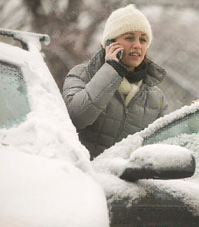
- If you have cell phone service, call for help.
- Be careful if you have to get out of your vehicle - use door away from traffic.
- Be careful if you attempt to free your vehicle from snow - dress warmly, shovel slowly, do not overexert.
- Draw attention to your vehicle.
Winter Driving Survival Kit
It's a good idea to keep a winter survival kit in your vehicle. Having essential supplies can provide some comfort and safety for you and your passengers should you become stranded. Recommended items:
- Ice scraper/snowbrush
- Shovel
- Sand or kitty litter
- Tow rope or chain
- Booster cables
- Road flares or warning lights
- Gas line antifreeze
- Flashlight & batteries
- First aid kit
- Fire extinguisher
- Small tool kit
- Extra clothing & footwear
- Blanket
- Non-perishable energy foods, e.g. chocolate or granola bars, juice, instant coffee, tea, soup, bottled water
- Candle & small tin can
- Matches
In blizzard conditions, especially overnight, make sure one person stays awake, because help could take some time to arrive. Maintain circulation by moving your feet, hands, and arms.
Return to Top
|
| Accidents |
|
ACCIDENTS will happen, as the saying goes. Some 20% of vehicles in an average fleet will be involved in an accident in any given year. Accidents are inevitable, whether caused by a fleet driver or a third party.
 What are best practices in accident reporting? There are several:
- Gathering Information - drivers should have the proper resources to report accidents quickly and accurately. Each vehicle should be equipped with a blank accident report and disposable camera (or cell phone with camera capabilities). Accident reports will be forwarded to each company car driver to be stored in your glovebox. Disposable cameras should be purchased, if needed.
- Routing the Report - drivers should report any accident to the Fleet Manager and their regional claims dept. The police should also be notified.
- Follow Up - drivers should review all reports for accuracy and completeness. All important information should be forwarded to the necessary individual.
You can find pertinent information in Sage regarding Accidents in the Driver Handbook. Just go the Home Page of Sage - under Table of Contents > CIC > General Information > Driver Handbook.
Return to Top
|
|
|
| 2007 Fleet Offerings |
|
Last month, we stated we would be talking about our 2007 Fleet offerings. As some of you know, we again offered the Chevrolet Impala, Pontiac Grand Prix, and Buick Lacrosse since we received very positive feedback on these vehicles in years past. Since the Buick Rendezvous was being discontinued in fleet year 2008, we decided not to offer it this year and chose as an alternative the Chevrolet Equinox (for claims personnel only). Another new vehicle added this year was the Chevrolet Uplander which has 7-passenger seating. The Uplander is being offered to all employees that may want additional seating capacity.
We encourage each of you to give your Fleet Dept. feedback on the vehicles being offered. You may contact either of us by phone or email.
Return to Top
|
| Did you Know? |
|
Did you know? - Driving Costs Average 52.2 Cents Per Mile
The overall average cost of operating a passenger vehicle is 52.2 cents per mile, or $7,834 per year based on 15,000 miles of driving, according to the American Automobile Association (AAA) 2006 "Your Driving Costs" study. The AAA study calculates the average costs of all expenses associated with operating vehicles more than five years and 75,000 miles of driving.
Return to Top
|
Side Airbags -
Reduce Driver Deaths by 37% |
|
A new Insurance Institute for Highway Safety Study reveals side airbags substantially reduce risk of death in cars and SUVs across the board. Airbags that protect people's heads are especially effective.
Side airbags that protect vehicle occupants' heads have reduced driver deaths in cars struck on the driver side by an estimated 37%. Airbags that protect only the chest and abdomen, but not the head, have cut deaths by 26%.
Head-protecting side airbags reduce driver fatality risk when cars are struck by SUVs and pickups, not just other cars. This finding is important since risks go up for occupants of cars struck in the side by the higher-riding vehicles. In particular, the car occupants' heads are vulnerable to being struck. Automakers are cooperating to reduce vehicle incompatibilities in both side and front collisions that lead to car occupant injuries, and a big part of this effort is to equip vehicles with side airbags.
Fatality risk in SUVs decreased 52% with head-protecting side airbags and 30% with airbags that protect the chest and abdomen but not the head.
Although federal regulations don't require side airbags in passenger vehicles, more manufacturers are installing them. A 2003 voluntary agreement among automakers will result equipping all cars, SUVs, and pickups with side airbags with head protection by the 2010-model year.
 Once every passenger vehicle on the road has side airbags that include head protection for front-seat occupants, as many as 2,000 lives per year can be saved.
Return to Top
|
|